Real-time experimental control DIII-D control
Turn a camera measurement into a control decision.
Image-based feedback for divertor detachment at DIII-D: connecting what the camera sees to how an experiment responds.
ContributionLead author · real-time emission-front control experiments
Project record2024–2026 · experiments & Nuclear Fusion paper
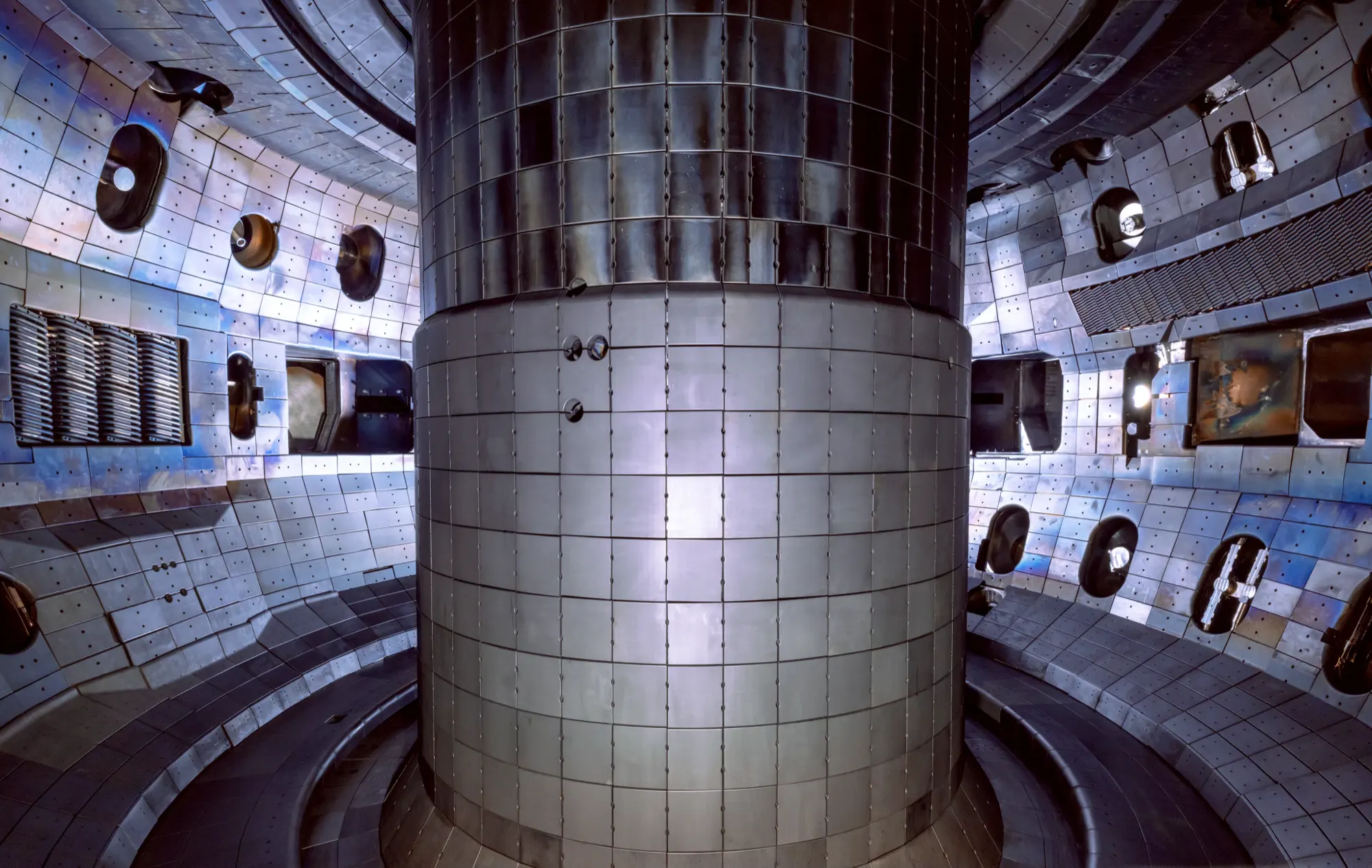
A fusion device must handle its exhaust
A plasma experiment has to manage the interaction between its exhaust and the surrounding material surfaces. Divertor detachment is one route toward reducing the heat reaching those surfaces. To control it, the experiment needs a measurement that can arrive and be interpreted in time to act.
This project uses images from DIII-D’s lower divertor camera to support feedback control. The measurement is part of a loop: observe the plasma, estimate the relevant state, adjust gas injection, and observe again.
Keep the real-time path interpretable
The work implements an AI-enabled framework with linear, interpretable processing in the real-time control path. The paper describes feedback experiments using deuterium gas to control detachment and reattachment.
I led the emission-front control work at DIII-D. It brings together model development, diagnostic processing, and experimental integration—the steps needed to turn an analysis method into something a running experiment can use.
The evidence is a closed loop
The open preprint reports a mean absolute difference of 2% from the target for both detachment and reattachment. The associated Nuclear Fusion paper provides the published account of the method and experimental validation.
For me, this is the point where scientific computing becomes especially useful: a measurement changes a decision, that decision changes the experiment, and the next observation tells us whether it worked.
Papers & resources
Read the published paper
Explainable image-based feedback control of divertor detachment in DIII-D · Nuclear Fusion, 2026
Read the open preprint
Method and experimental validation · arXiv